Dynamic load-management hardware
aCharge Controller
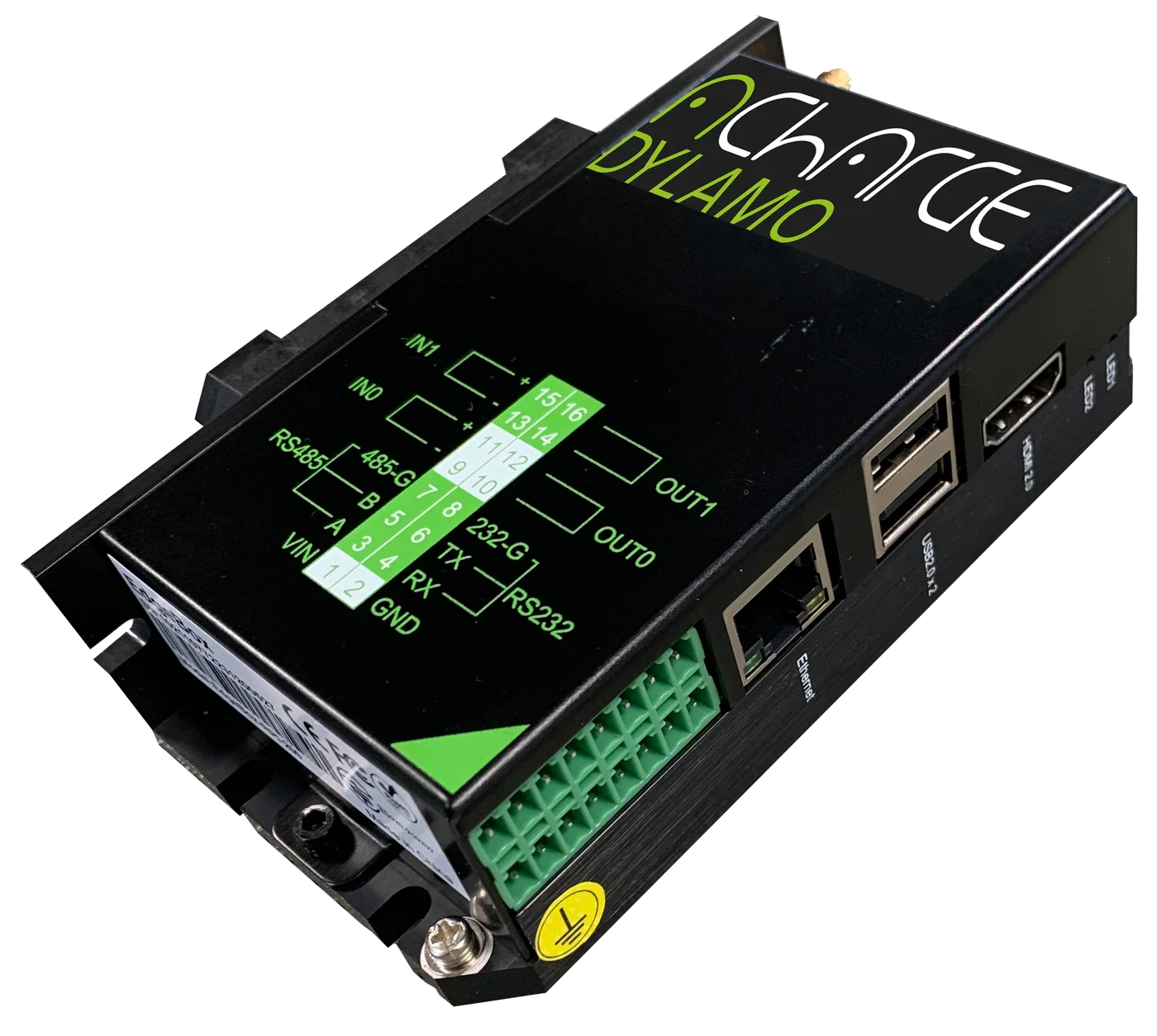
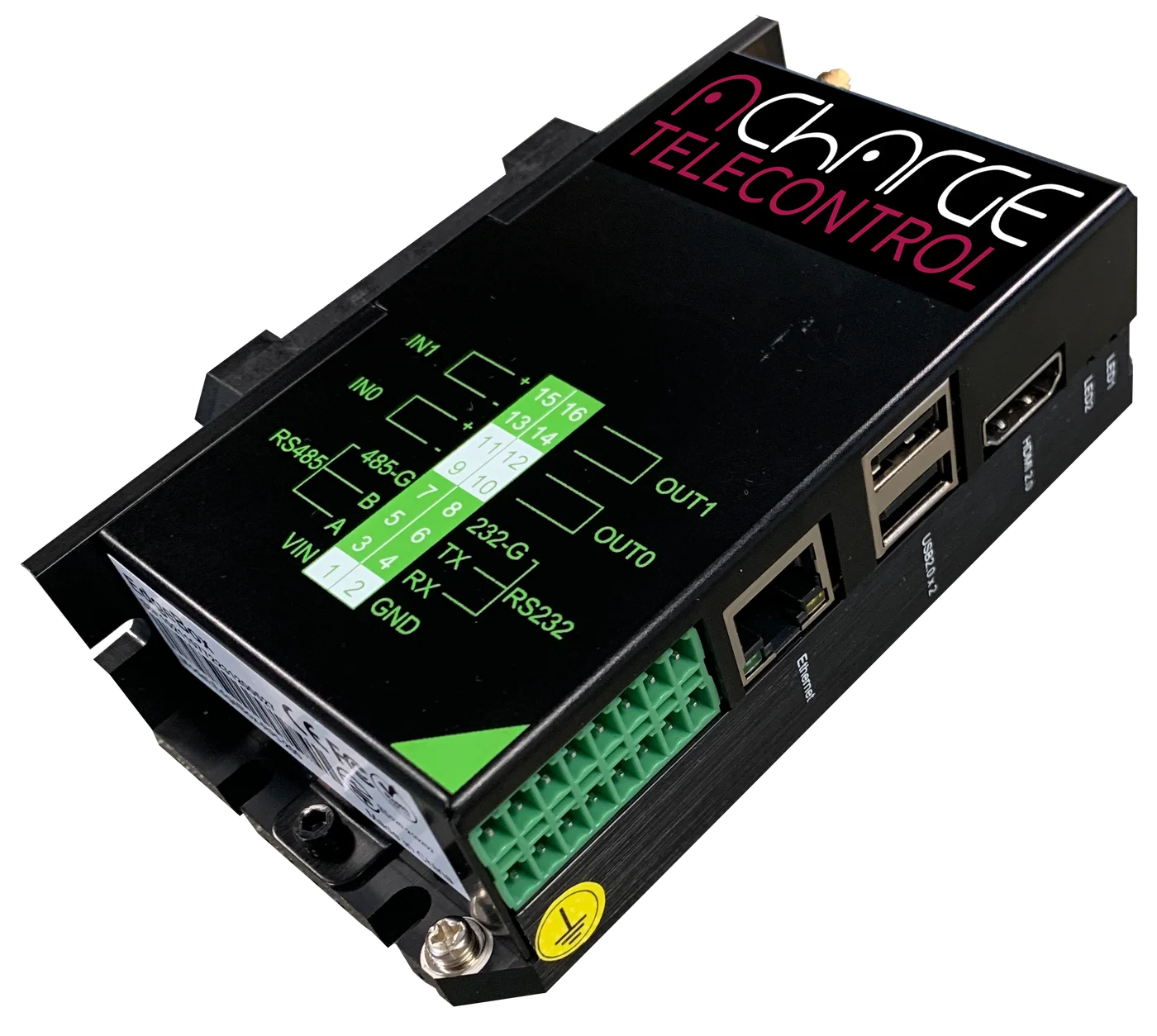
The aCharge Controller runs your load management directly on site — the same hardware, two tiers: TELECONTROL for a straightforward entry point, DYLAMO for maximum capability at complex sites.
How it's wired
Where the controller sits
The controller sits between the meter and the charge points. It measures what the building is drawing and releases to the charge points whatever the connection has to spare — locally, without a detour through the cloud.
Load management, explained interactivelyFundamentals
What is dynamic load management?
Every building has one hard ceiling: its grid connection. Put together, charge points almost always want more than that ceiling allows. Dynamic load management solves this with metering and software instead of an expensive grid upgrade — it measures what the site actually draws, works out how much capacity is left, and hands that out to the vehicles. Second by second, all day long.
- Six charge points want
- 66 kW
- The connection delivers
- 43 kW
- Below this current no car charges
- 6 A
The cable is the bottleneck
A typical 63 A commercial connection delivers around 43 kW. Six 11 kW wallboxes want 66 kW — more than the connection can give. Without control the main fuse trips, or a grid upgrade runs into five figures.
Static: safe, but wasteful
Static load management reserves a fixed budget for the charge points — sized against the building's peak load so it is safe at every hour. It works, but in the evening, when the building draws almost nothing, 30 kW sit unused in the cable.
Dynamic: the leftovers, in real time
The controller measures the real draw at the building's supply point and releases exactly what is spare to the charge points. When the building load rises, the vehicles throttle back. When it falls, they charge faster. The connection limit is never exceeded — and never needlessly left unused.
Interactive simulation
One day at an example site
6 charge points at 11 kW each on a 43 kW connection. Switch the strategy and watch what happens to the site.
No control: Every vehicle pulls whatever it can. The cars do get full — but the grid draw shoots far past the connection limit. In reality, this is where the main fuse trips.
Static: A permanently reserved budget of 10 kW, sized for the building's peak load. Safe at every hour — but it only stretches to two vehicles at a time, and in the evening the free capacity goes unused.
Dynamic: The budget is whatever the connection has spare right now. At midday, under full building load, charging throttles back; in the evening everyone charges at full power — without ever touching the limit.
At the connection now
- Building
- 0 kW
- PV
- − 0 kW
- Charging
- 0 kW
- Grid draw
- 0 / 43 kW
- Spare
- 0 kW
Connection limit exceeded by 0 kW
Grid operator throttling: max. 4.2 kW for controllable loads
Van · deliveries
06:00 – 14:00 · 75 kWh
Company car · field sales
07:00 – 17:30 · 60 kWh
Employee A
08:00 – 17:00 · 52 kWh
Employee B
08:30 – 16:00 · 40 kWh
Visitor
10:00 – 12:30 · 58 kWh
Pool vehicle · late shift
16:00 – 21:00 · 80 kWh
| Strategy | Delivered | Avg. state of charge on departure | Vehicles ≥ 80 % | Peak grid draw | Over the limit |
|---|---|---|---|---|---|
| No control | — kWh | — | — | — | — |
| Static | — kWh | — | — | — | — |
| Dynamic (DYLAMO) | — kWh | — | — | — | — |
Simplified simulation using example values: 63 A connection (≈ 43 kW), six 11 kW charge points, a typical commercial load profile and six vehicles with different dwell times. Real sites are dimensioned individually.
Under the hood
Four steps, every second
Measure
A meter at the building's supply point reports actual real power — per phase, continuously. Not the number on the datasheet, but what is genuinely flowing right now.
Compute
The controller subtracts that from the contracted connection capacity. Whatever is left is the free budget — plus whatever the PV system is generating on site.
Distribute
The budget is split across the occupied charge points — by priority, dwell time and state of charge. Never below 6 A per vehicle, because below that no car charges at all.
Fail safe
The controller regulates locally, not in the cloud. If the internet connection drops, load management carries on unchanged and re-syncs automatically once it returns.
When one dimension is no longer enough
Simple dynamic load management tracks one quantity: the spare capacity at the connection. At larger sites, though, other loads and generators hang off the same cable — and they move that budget constantly. DYLAMO factors all of them in rather than ignoring them.
- On-site PV generation
- Heat pumps
- Transformer load
- Charge points from multiple vendors
- Priority and dwell time per vehicle
- Vehicle battery state of charge
When the grid operator throttles
Since 2024, German grid operators may temporarily throttle controllable consumers — wallboxes, heat pumps, batteries — down to 4.2 kW when the grid is at risk of overload, in exchange for reduced grid fees. The aCharge Controller accepts that signal and still allocates even the reduced budget by priority, rather than hard-stopping charge points.
Try the “Grid operator dimming” switch in the simulation above — it throttles the evening peak from 17:00 to 20:00.
More charge points on the same connection
The economic core of dynamic load management is not the technology but what it avoids: a bigger grid connection. Instead of sizing the cable for a theoretical worst case where everything runs at once, the existing connection is used as far as it safely allows — and the site can grow without the excavators coming back.
Simple dynamic load management
aCharge Controller — TELECONTROL
Single-stage load management with a local controller — designed for compact, reliable installations that keep running safely even when the internet connection drops.
- Single-stage load management without complex multi-system integration
- Standardized interfaces: potential-free contacts, Modbus TCP, EEBus
- Keeps running safely, even offline
- Automatic re-sync with the cloud
Multi-dimensional load management
aCharge Controller — DYLAMO
Multi-dimensional load management for charging sites that grow with you: DYLAMO distributes available connection capacity in real time across charge points from different vendors, PV systems, heat pumps and transformers.
- Distributes power in real time based on priority, dwell time and battery state
- Connects wallboxes from multiple vendors via standard protocols
- Integrates PV generation, heat pumps and transformer load
- Metrology-compliant metering and billing of every charging session
TELECONTROL or DYLAMO?
The difference at a glance
| TELECONTROL | DYLAMO | |
|---|---|---|
| Load management | Dynamic, single-stage | Dynamic, multi-dimensional |
| Integrates other assets | — | PV, heat pumps, transformers |
| Interfaces | Potential-free contacts, Modbus TCP, EEBus | Standard protocols across vendors |
| Offline operation | Local controller, automatic re-sync | Local controller |
| Compliant with | EnWG §14a, VDE-AR-N4100 | EnWG §14a, VDE-AR-N4100 |
| Ideal for | Simple, compact charging sites | Complex, growing sites |
Compliance & regulation
Both variants of the aCharge Controller meet the requirements of EnWG §14a (grid-friendly control) and VDE-AR-N4100.
View certificates & documentsDo you install, specify or recommend aCharge?
Whether you're an electrician, planning office or construction company: recommend the aCharge Controller to your customers — we share the work, we share the gain.
View partner programsWhich variant fits your site?
We'll work with you to find out whether TELECONTROL or DYLAMO fits your situation.
Get in touch